
Updated
Start with a repeated job, not an AI subscription
The wrong first move is choosing software. The right first move is finding a repeated job with consistent inputs, a checkable output and an acceptable consequence when the first draft is wrong.
That distinction matters because a long or irritating task is not automatically suitable for AI. If an unchecked error could commit money, affect an employee or create a contractual problem, its apparent time-saving potential is beside the point. High risk must act as a gate, not a minor deduction in an otherwise attractive score.
The operating task I recommend is simple: select one real job, define what AI may prepare, calculate its plausible capacity value and test the output under human review. You can do all of that without buying my toolkit or another piece of software.
Begin with work already happening in your business. Write down repeated tasks rather than imagined uses for AI. Good candidates tend to involve summarising, organising, comparing, classifying or preparing a first draft that a person can check quickly.
Examples include turning approved notes into a first-draft SOP, extracting frequently asked questions from support messages, researching public facts before a sales call, drafting CRM notes from a transcript or checking a document for missing required sections. These are preparation tasks. They do not hand software authority over money, people or commitments.
Score the task, with risk as the first decision gate
Take each candidate and score its frequency, time requirement, repetition, process consistency, business benefit, risk and ease of implementation. Do not let a strong score elsewhere cancel out serious risk. If the work could make an irreversible or high-consequence decision, AI should not own it or execute it.
Payments, contracts, hiring, firing, discipline, and final legal, tax or regulated financial advice stay human. AI may organise relevant information beforehand, but a person remains responsible for the decision.
Some preparation work sits between low-risk administration and decisions that must remain human. Pricing scenarios, sensitive complaint responses, proposal scope, employee communications and marketing claims may be useful AI tasks, but only with an explicit approval gate. Name the person who approves the output rather than relying on a vague instruction to “check it”.
Once a task passes the risk gate, look for consistent inputs and an output that can be judged against something concrete. If staff cannot agree what a good result contains, the task is not ready for an AI assistant. Fix the process definition first.
Your first no-purchase action is to choose one task completed regularly and answer four questions on paper:
- What exact material goes in?
- What exact preparation should come out?
- Who can check it quickly and against what source?
- What must the system never decide, publish, send or approve?
Turn the chosen task into a bounded job
A useful AI assistant is a job definition with boundaries, not a fashionable title. “Marketing assistant” is too broad. A defined purpose such as turning approved customer interviews into first-draft case studies for the marketing owner is testable.
Write the purpose as one sentence naming the person or team supported and the output prepared. Then list the approved input material and its order of authority. Identify information that changes quickly, what must be checked every time and what the assistant should do if two sources conflict.
Next, create an output contract. Specify the fields, structure, intended reader and maximum useful length. Require the output to show its assumptions, sources and outstanding checks. That makes review part of the process rather than an afterthought.
Separate preparation from authority in plain language. The assistant may draft, summarise, organise or compare. It must stop for approval where the work touches money, contracts, people decisions, sensitive customers, public claims, regulated matters or irreversible actions.
Illustrative example: suppose a business wants to turn meeting notes into decisions and owned actions. The approved input is the meeting record. The output contract could require separate sections for decisions, actions, owners and unresolved questions. The assistant should flag any action without a named owner instead of inventing one. A person who attended the meeting checks the draft before it enters the working task system.
That example is suitable because the output is structured and quickly checkable. It does not authorise the assistant to assign responsibility, make a commitment or send instructions on behalf of the business.
Measure the whole job, including checking
A technically workable task still may not justify paid software. Before subscribing, establish an honest baseline for the current workload and include the cost of checking AI output.
Calculate current annual hours by multiplying hours per task by annual occurrences and the number of people involved. Multiply that result by a realistic hourly employment cost, including the costs you normally include when planning capacity. Do not use a director’s charge-out rate unless that is genuinely the capacity being released.
Then estimate the gross reduction in drafting or processing time. Subtract the annual time required to prepare inputs, review outputs, correct errors and maintain the process. Run a conservative case first. The remaining hours are the net capacity potentially released.
When evaluating a product, include its subscription or purchase cost as well as implementation, integrations, training, maintenance and review time. A £20 subscription can still be expensive when the process needs two hours of senior checking every month.
Do not label all released capacity as profit. It becomes cash only when a cost is actually removed. It may instead support faster responses, more consistent work or more useful activity from the same team. Those can matter, but they should be described accurately.
My decision rule is firm: if you cannot explain the commercial return in one sentence, do not subscribe yet. Continue defining and testing the job until the inputs, review burden and plausible capacity value are clear.
- Current annual hours = hours per task × annual occurrences × people
- Gross hours saved = current hours × expected reduction
- Net hours saved = gross hours saved − annual setup and review hours
- Annual capacity value = net hours saved × hourly employment cost
Test ordinary, messy and high-consequence examples
Do not approve a reusable assistant after one polished example. Test it against three real cases: an ordinary case, a messy case and a high-consequence edge case.
The ordinary case shows whether the basic job definition works. The messy case reveals what happens when information is missing, inconsistent or badly structured. The edge case checks whether the approval boundary holds when an error would matter more.
Record the correction time and reason for every correction. This is the review check for the whole method. If the output is quick to produce but slow to verify, the task may not release useful capacity. If failures repeat, update the reusable instruction. Do not add rules merely to correct a one-off issue unless the same failure could happen again.
Common mistakes are choosing a tool before a task, selecting work because it takes a long time while ignoring consequence, giving the assistant a broad job title, leaving approved sources undefined and treating review time as free. Another is allowing a human approval instruction to remain anonymous. Approval belongs to a named role or person.
After the three tests, make a keep, revise or stop decision. Keep the task when its outputs are checkable, its boundaries hold and the conservative capacity case remains credible. Revise it when recurring failures can be addressed through clearer inputs or instructions. Stop when review effort or risk outweighs the value of the preparation.
Use the toolkit when you want the method packaged
I create and sell Stop Buying AI Tools through my Business Fix range. It is a one-off digital purchase, and no software or consultancy is included.
I would consider it if you are a small-business owner who has real recurring work to assess but wants a structured route through scoring, role design, approval boundaries, quality control and capacity value. I would not buy it if you want software to make final decisions, remove human accountability or produce a commercial result without implementation and review.
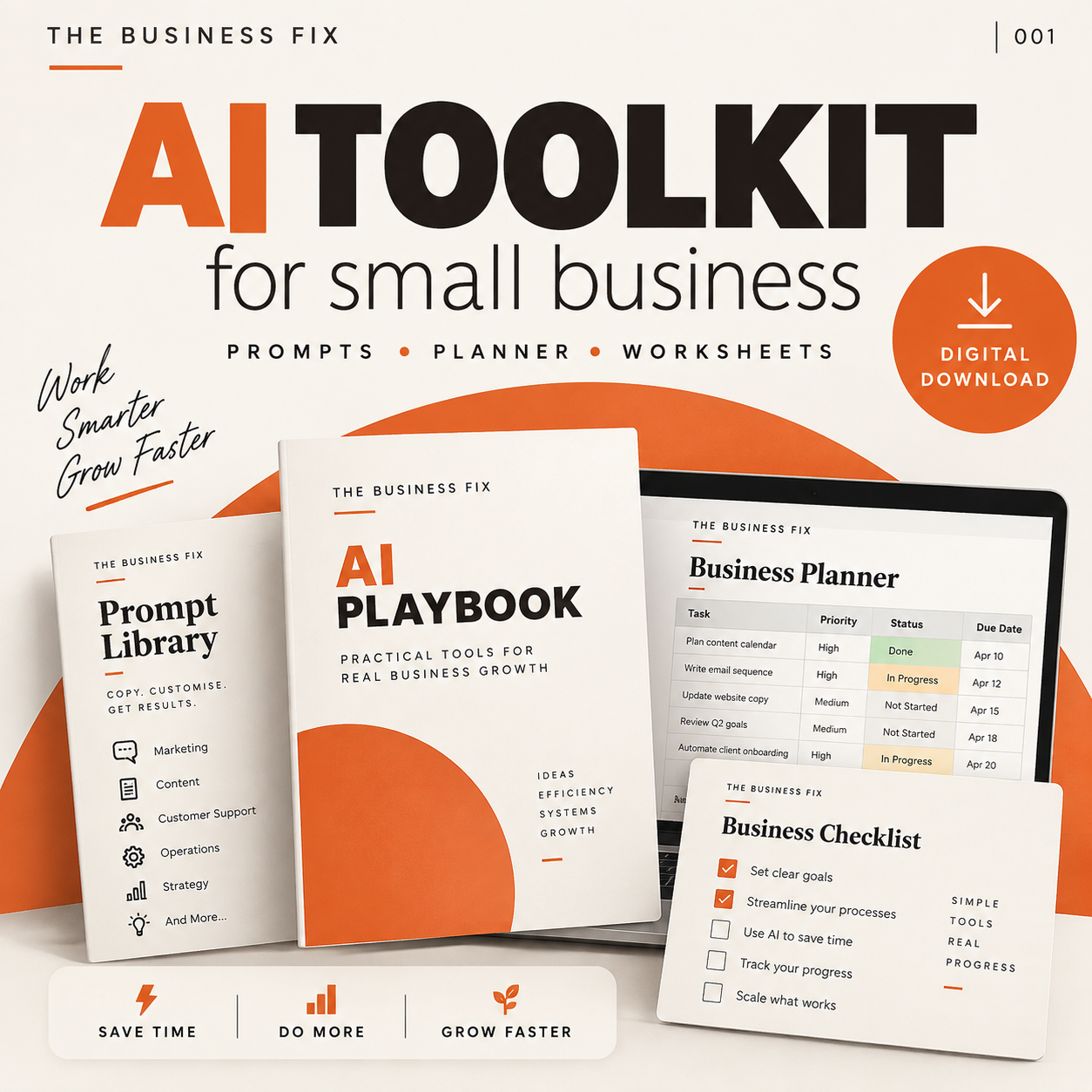
The downloadable toolkit packages the method into working files. The Start Here PDF provides an ordered route. The AI Opportunity Scorecard helps separate do-first opportunities from risky distractions, while the AI Task Library contains 75 realistic SME tasks with suitability, risk, benefit and approval guidance.
For implementation, the AI Employee Builder feeds into a vendor-neutral Master AI Employee Prompt. There are also marketing, sales and operations assistant roles. The Human Approval Checklist and twelve-point AI Quality Control Checklist support the review boundary, while the Time Saved / Commercial Value Calculator provides a conservative way to assess capacity value and payback. The 30-Day Implementation Plan moves from audit to two tested roles and a keep/stop decision.
Before trying it, write down one repeated task and complete the four input, output, reviewer and authority questions above. If that exposes a real candidate but you want the scorecards, role-design documents, buying filter and implementation plan rather than building them yourself, check the current Stop Buying AI Tools product page: https://chrisgjones.co.uk/business-fix/stop-buying-ai-tools