Updated
A form that looks good but leaves a request in an unmonitored inbox is a broken sales process, not just a design problem. I would fix that before paying to send more visitors towards it.
The method is simple: review one important page as a prospective buyer, identify the action it should earn and follow that action into the business. You can do all of this without buying my toolkit.
Illustrative starting situation: “get in touch” says too little
This is an illustrative example, not a client case study or a personal result.
A maintenance company asks website visitors to “get in touch”, but does not explain what information the team needs. The visitor cannot tell whether to describe the job, provide its location or choose how they want to be contacted. The page also says nothing about who will review the request.
The immediate temptation might be to redesign the section or buy more traffic. I would do neither. The buying obstacle is uncertainty, so the next change should remove uncertainty.
The decision: repair the enquiry path, not the page decoration
The company chooses one action for the page to earn: a useful maintenance enquiry that the business can receive and review.
Before changing anything, it reviews the page in the order a buyer reads it. On a phone, before scrolling, can a new visitor tell what the company does, whom it is for and what to do next? If the answer is no, those clarity issues belong in the same review, but they should not distract from a broken contact path.
The enquiry section is then changed so it asks for the job location, type of work and preferred contact method. It also explains who will review the request. Any stated response time must be one the team can actually meet.
Working through the change
- Name the intended buyer for the page.
- State the maintenance problem and the outcome clearly.
- Mark the facts, supporting evidence and unanswered objections on the page.
- Choose one clear call to action rather than presenting competing next steps.
- Specify the information needed to assess the enquiry: job location, type of work and preferred contact method.
- Explain who will review the request without promising a response time the team cannot meet.
- Assign an owner for the website change and for the request after it enters the business.
- Record what changed and what evidence will be reviewed.
Evidence should sit near the claim it supports. It might be a real example, a relevant qualification or an explanation of the process. A logo strip is not a substitute for permission to use those logos or evidence of what the company did. Unsupported statements should be corrected before their presentation is polished.
What would change in another business
The exact fields and internal route depend on the buying decision and the information genuinely needed for the next step. The maintenance company needs a job location and type of work. Another business may require different information, so copying these fields without examining its own process would miss the point.
The constant is the decision path. Name the intended buyer, state the problem and outcome, show evidence you can substantiate, make one call to action clear and test the contact path on mobile.
I would not add fields merely because they may be useful later. The page should ask for what the business needs to take the stated next step, while making that step understandable to the prospective buyer.
The check starts after the button is pressed
The company submits the form itself using clearly labelled test information. It checks the validation, success message, notification delivery and the next step inside the business.
Publishing the change is not proof that the problem has been fixed. The test must show that a visitor can complete the path and that the request reaches the person or place responsible for handling it.
The company records what changed and how it will assess the change. Qualified enquiries matter alongside raw clicks, with allowance for changes in traffic source and demand. A small number of visits cannot prove that a new headline caused a conversion improvement. Early results are a signal to investigate, not a case study.
Common mistakes that leave the obstacle in place
- Redesigning the section before identifying the buying obstacle.
- Using a broad call to action such as “get in touch” without explaining what information is needed.
- Promising a response time the team cannot meet.
- Testing how the form looks but not where its submission goes.
- Allowing notifications to arrive in an unmonitored inbox.
- Adding competing calls to action before the main contact path works.
- Treating publication as proof of improvement.
- Claiming an improvement from too little evidence or ignoring changes in traffic source and demand.
Where the working files help
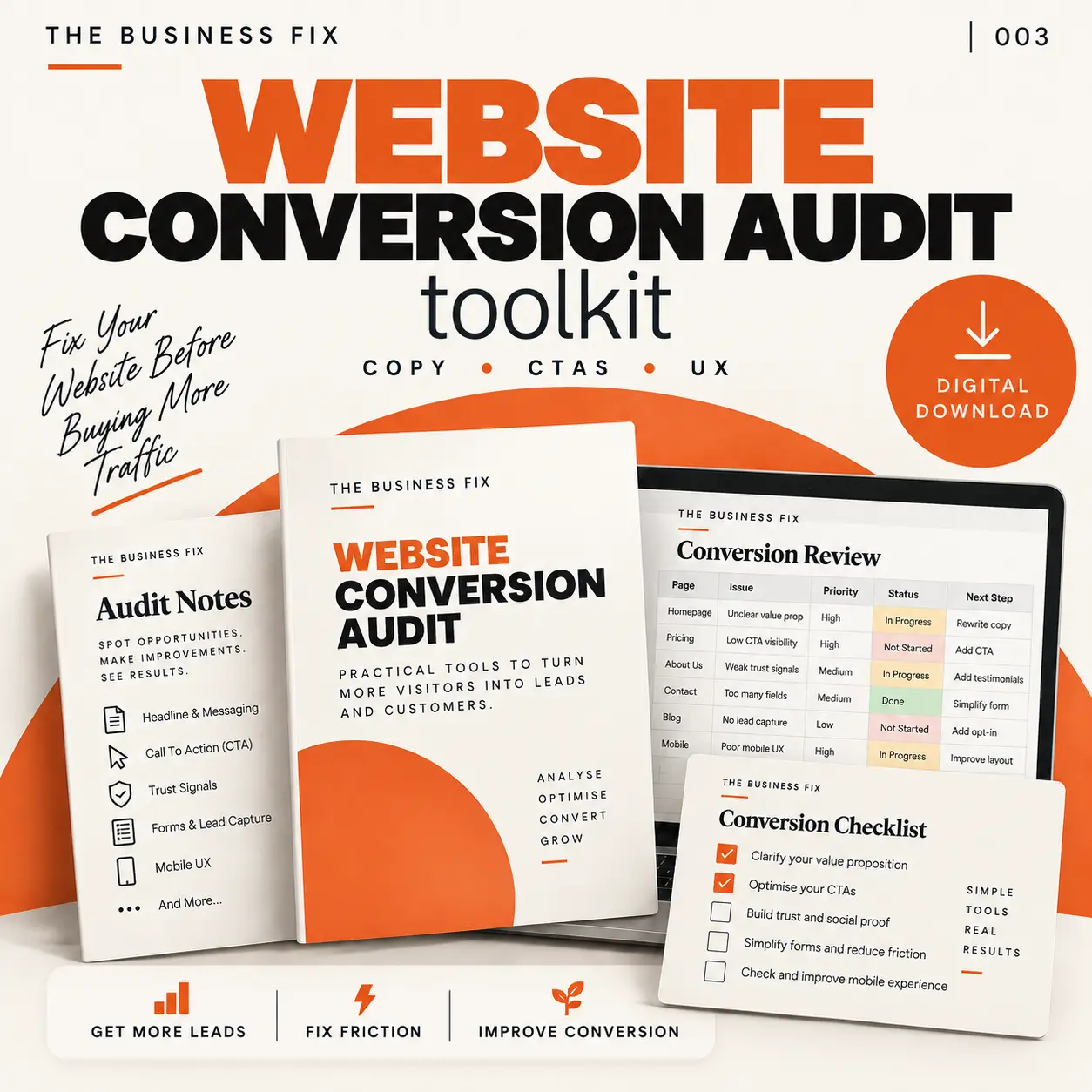
Fix Your Website Before Buying More Traffic is my conversion-focused website toolkit. I create and sell it as a one-off digital purchase, so the commercial relationship is direct. The current product page is https://chrisgjones.co.uk/business-fix/fix-your-website.
Its job is to help structure improvements to proposition, evidence, calls to action, contact paths and mobile friction without assuming that everything needs redesigning. It does not include software or consultancy, and it cannot approve a claim, monitor an inbox or implement a change for you.
The Website-fix starting guide focuses the review on clarity, trust and friction. The Website conversion scorecard and issue register lets you rate the homepage, offer, calls to action and friction with supporting evidence, then keep each page issue and next action in the register.
Once the decision is made, the Website change brief records the decision, evidence and owner so someone can act. The Website change review then helps check the chosen fix, its owner and the evidence to review rather than treating publication as proof.
The AI website-review prompt asks AI to review page material you provide and distinguish observations from assumptions before you approve changes. The Page-clarity review prompt reviews supplied page copy for clarity with a draft and human-check list. It does not crawl or change your website.
I would not buy the toolkit if you only want someone else to redesign or operate the website. I would use it when the job is to turn an uncertain website review into recorded decisions, assigned actions and a defined check.
The relevant next action
Open your most important service page on a phone and review it as a prospective buyer. Mark the facts, evidence, unanswered objections and the one action the page should earn. Then complete that action yourself and follow it until you can see who owns the next step inside the business.
If the path fails, fix that before buying more traffic. If it works, move to the next highest-consequence issue: broken forms, unreadable mobile layouts and incorrect contact details come before unclear offers, missing decision information and competing calls to action. Cosmetic changes can wait while a buyer still cannot understand or complete the enquiry.