
Updated
A weekly business review that produces no clear decisions is just a status meeting. If actions leave the room without an owner, evidence and a review date, the same issues will return next week.
The operating task is simple: take a small amount of reliable information, identify what needs attention, make the necessary decisions and keep the resulting actions visible until they can be checked.
Prepare the inputs before the meeting
Do not use meeting time to assemble basic information. Prepare a short record covering numbers, priorities, customers, issues, open actions and decisions required.
Start with a small set of measures that indicate whether delivery, customers or cash need attention. Each measure needs a definition, a source and a person responsible for updating it.
Ambiguous measures create false precision. “Sales” might mean enquiries, accepted proposals, invoices or money received. Unless everyone knows which meaning applies, the number cannot support a clear decision.
For each measure, state what change should trigger a question. The aim is not to build a dashboard of everything the business can count. It is to bring enough reliable evidence to decide what deserves action before the next review.
Work through six questions in order
A useful review follows a short, repeatable sequence. The order matters because it moves the discussion from evidence to attention, then from attention to responsibility.
- What changed in the numbers?
- What matters this week?
- Which customer needs attention?
- What issue needs a decision?
- Who owns each action?
- When will the decision be reviewed?
Use the first three questions to identify exceptions. Spend meeting time on changes, trade-offs and decisions that need more than one person. Routine updates can remain in the prepared record.
When an issue needs detailed investigation, move it into a separate discussion involving the people who can resolve it. Otherwise the weekly review becomes a long problem-solving session while everyone else listens.
Separate observations from actions
Naming an issue does not resolve it. The critical decision point is whether the discussion has produced a specific change that someone can carry out.
That distinction keeps the review practical. The issue describes what is happening. The action states what will change. Ownership identifies who will make that change happen, while the review date prevents the decision from disappearing into old meeting notes.
Keep one working action record
Keep decisions and open actions visible after the meeting. Carry unfinished actions forward with their existing owners instead of creating a new list each week.
A useful action record should make the decision, owner, completion evidence and next review date clear. The record does not need to be elaborate. It needs to survive between meetings and show what still requires attention.
Do not close an action because somebody says it is done. Close it when the agreed result can be checked.
Run the review check
At the next meeting, check whether the agreed change was used and whether the issue occurred again. In the illustrative service-team example, the review would check whether readiness was confirmed before booking and whether jobs were still delayed by missing customer information.
If an item remains open, do not simply repeat its label. Decide whether to change its scope, provide capacity or explicitly stop it. Repetition without a new decision is not progress.
Avoid the mistakes that weaken the routine
- Counting everything rather than selecting measures that lead to decisions.
- Using undefined terms such as “sales” without agreeing what the number represents.
- Preparing numbers during the meeting instead of beforehand.
- Treating an observation as though it were an action.
- Assigning an action without naming one owner.
- Allowing detailed problem-solving to consume the whole review.
- Starting a fresh action list while previous commitments disappear.
- Closing work without checking the agreed evidence.
- Carrying the same item forward without changing its scope, capacity or status.
Start without buying anything
For your next review, create a single page with six headings: numbers, priorities, customers, issues, actions and decisions. Choose a small set of measures, define each one, note its source and assign responsibility for updating it.
During the review, select one exception that requires a decision. Record the change required, one owner, the evidence that will show completion and the date when you will review it. Carry that same record into the following meeting.
If this lightweight routine works, keep it. You do not need a toolkit merely to ask better questions and maintain an action record.
Where Build Your Business Operating System fits
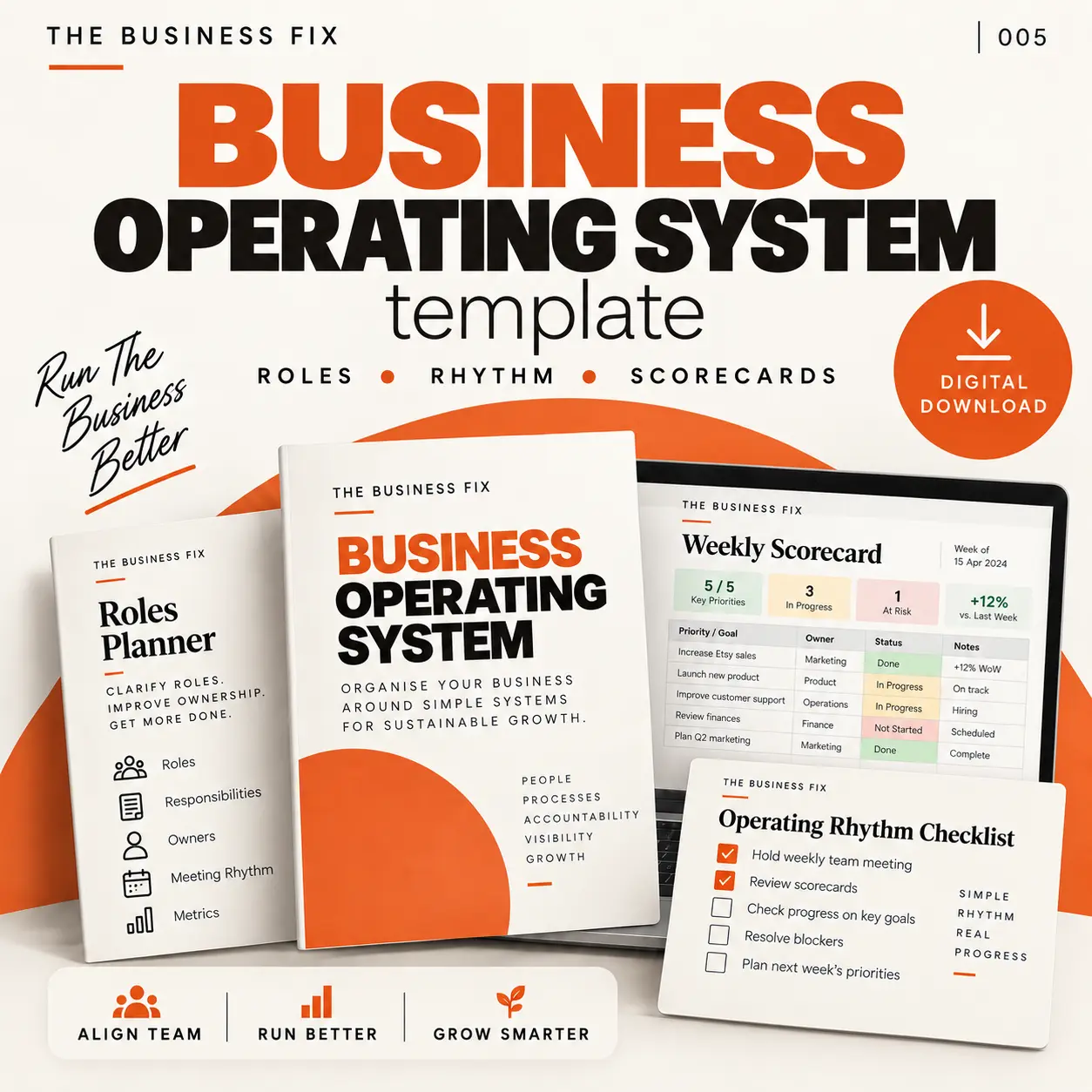
I create and sell Build Your Business Operating System. It is a one-off digital Business Fix toolkit for owner-managed businesses that need visible priorities, useful measures, clear responsibility, simple reviews and documented recurring work.
The toolkit supports the wider Business Bottleneck Audit method. Selected files include a management rhythm starting guide, a management bottleneck scorecard and action register, a management decisions worksheet, prompts for drafting business reviews and preparing meetings from approved notes, and a management action check.
The prompts are there to prepare material from information you supply and identify unknowns requiring a person’s decision. They should not be used to invent figures or commitments.
I would consider the toolkit when the method is understood but the business needs a more structured way to assess its reviews, measures, responsibilities and decisions, then keep evidence and next actions visible. I would not buy it if the immediate need is simply to test whether a short weekly review can produce one owned, checkable decision.
No software or consultancy is included. The current product details are available on the Build Your Business Operating System page: https://chrisgjones.co.uk/business-fix/business-operating-system
The decision rule is straightforward: first prove that your team can move from evidence to an owned action and check it at the next review. Add the toolkit only when you need a consistent operating structure around that discipline.