
Updated
A blank document is enough to productise a service if you already know which decisions to make and have the discipline to test them against delivery evidence. Productise Your Service Business earns its place by structuring those decisions, not by replacing the commercial judgement behind them.
I create and sell this Business Fix toolkit, so I have a direct commercial interest in the purchase. No software or consultancy is included, and buying the files does not promise a commercial result.
Start with one service, not your whole business
The job is to make the repeatable part of one service clear enough to explain, price and deliver consistently. It is not to remove useful expertise or force every customer through identical work.
Custom does not have to mean undefined. A sound package separates the standard core from optional work, bespoke work and exclusions. It also says what the customer must provide, where your responsibility ends and how both sides know the work is complete.
Before opening any template, select a service with a recurring problem, outcome and delivery pattern. Then compare several completed jobs of that kind. Look at the actual delivery work rather than relying on proposal wording.
- Record the common problem and the buyer's starting situation.
- Identify the promised output and the steps that genuinely repeat.
- Mark what was always included, optional, custom or excluded.
- Check where judgement remained necessary.
- Use the next suitable proposal to test the scope.
If every job requires a different diagnosis, a defined discovery service may be a better first product than a fixed delivery package.
What a blank document can do
You do not need to buy a toolkit to apply the method. A blank document, spreadsheet and your existing delivery records can be enough.
Write down the buyer, outcome, scope, deliverables, turnaround, responsibilities, exclusions, support, price and next step. Add a simple model covering delivery cost, gross margin, monthly capacity, overhead break-even volume and the price needed for your target margin. Keep a record of why each decision was made so that the team does not reopen the same questions without new evidence.
This route works when you already have a reliable internal process for service design and costing. Its weakness is not the empty page itself. The risk is overlooking a decision, hiding difficult delivery work behind tidy sales language or repeatedly changing boundaries without recording why.
What the paid files add
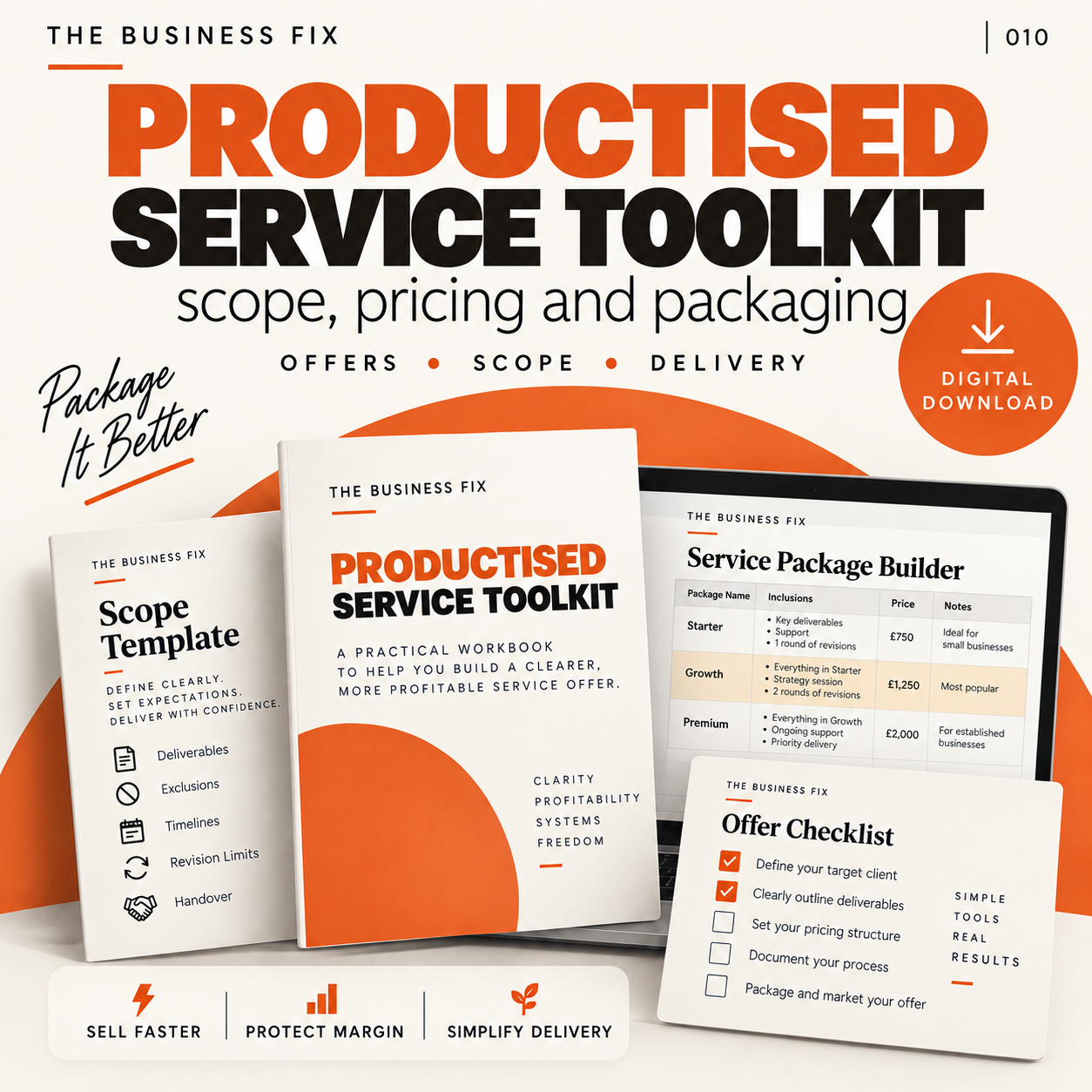
The toolkit supplies a defined route through the work. Selected files include a starting guide for choosing a suitable service and a readiness scorecard for assessing repetition, customer similarity, definable scope, cost and customisation needs.
A service design decisions worksheet records the evidence and choices behind the standard core, customer outcome, package and economics. The service package definition then prompts you to describe one offer's buyer, outcome, scope, deliverables, turnaround, responsibilities, exclusions, support, price and next step.
The economics calculator covers delivery cost, gross margin, monthly capacity, overhead break-even volume and the price needed for your target margin. A package implementation review helps you check the first package decision against delivery evidence before keeping, refining or abandoning it.
That structure is the reason to buy. It reduces the work of designing your own decision process, but it does not make the decisions for you.
Preparation the toolkit cannot remove
You still need evidence from completed work. Gather several comparable jobs, their actual delivery steps, requested exceptions, customer inputs and the effort involved. Without that preparation, a polished package can merely standardise your assumptions.
You also need a candidate service narrow enough to examine. Trying to package every service at once makes it harder to distinguish a genuinely repeatable core from convenient wording.
Ask another person to read the proposed offer and describe what they think they would receive. Any disagreement exposes weak boundaries, particularly around inputs, completion and support.
The buyer still owns the difficult work
The toolkit does not own service selection, evidence quality, package judgement, pricing decisions or implementation. You remain responsible for deciding where standardisation is sensible and where expertise must remain flexible.
You must also pilot the offer. Use the next suitable proposal, then record objections, requested exceptions and actual delivery effort. When an exception recurs, decide whether it belongs in the standard core, needs a priced option or shows that the package targets the wrong starting situation.
Do not assume a simpler offer must be cheaper. Cost and capacity need checking separately. A clear package can still be uneconomic, and a fixed package without an acceptance point can still become unlimited work.
Common mistakes to avoid
- Starting with proposal language instead of evidence from delivery.
- Trying to standardise every service before testing one.
- Treating necessary professional judgement as a defect to remove.
- Leaving customer responsibilities, exclusions or the completion point vague.
- Concealing complexity that the delivery team will still have to absorb.
- Making recurring exceptions without deciding whether to change the core, add an option or reject the fit.
- Assuming clearer packaging automatically justifies a lower price.
Who should not buy it
I would not buy this toolkit if you already have a working internal process that covers readiness, package definition, economics and post-pilot review. You can follow the public guide and build the documents yourself.
I would also avoid it if you are unwilling to inspect completed work or test the package through a suitable proposal. The files cannot compensate for missing evidence. Nor would I use productisation to disguise a service that needs a fresh diagnosis every time.
An honest suitability check
Before buying, answer four questions.
- Can you name one service with a recurring problem, outcome and delivery pattern?
- Can you compare several completed jobs and identify what genuinely repeats?
- Do you need a structured set of files for defining, costing and reviewing the package?
- Are you prepared to own the decisions and test them in a real proposal?
If the first two answers are no, do the preparation before buying. If all four are yes but you already have an equivalent internal process, keep using it. If you have the evidence but lack a reliable structure for turning it into a testable package, review the current Productise Your Service Business page at https://chrisgjones.co.uk/business-fix/productise-your-service.